
For every rupee in the government coffer, 58 paise will come from direct and indirect taxes, 34 paise from borrowings and other liabilities, six paise from non-tax revenue like disinvestment and two paise from non-debt capital receipts, according to the Budget documents for 2023-24.
President Trump with his MAWA has unwittingly provided us this opportunity. Will PM Modi grasp this and leave a legacy of an ushered in scientific and technological revolution in India, asks Colonel Anil A Athale (retd).

The GST Council has set up a Group of Ministers, chaired by Haryana Deputy Chief Minister Dushyant Chautala, to suggest required changes in the law for setting up the GST Appellate Tribunal (GSTAT). The GST Council, chaired by Finance Minister Nirmala Sitharaman and comprising state ministers, had last week decided to constitute a Group of Ministers (GoM) to address various concerns raised by states in relation to constitution of the GSTAT. As per the Terms of Reference (ToR) of the GoM, the panel would recommend required amendments in the GST law to ensure that the legal provisions maintain the right federal balance and are in line with the overall objective of uniform taxation within the country.

The demand for extension of the GST cess regime among others was made by several state finance ministers at a pre-budget consultation called by Union Finance Minister Nirmala Sitharaman in New Delhi. Besides, many states also demanded raising the share of the Union government in the Centrally Sponsored Schemes (CSS). Currently, the central government and state government share in some CSS is 60:40 while in others it is 75:25.

The panel decided to omit the reverse charge mechanism (RCM) clause from the GST law under which registered taxpayers buying from unregistered taxpayers have to deposit the GST.

'The bull market cycle ran for five years. It's the end of that cycle.' 'The next cycle is a down cycle, and in that down cycle, you will see the Sensex falling from their highs of around 68,000 to maybe 40,000-50,000 at the bottom of the cycle.'

The Centre has recovered around Rs 95.86 crore from at least 11 crypto exchanges for evading goods and services tax (GST), according to data released by Parliament on Monday. The amount includes interest and penalty. The GST investigation department has detected a total tax evasion of Rs 81.54 crore by crypto exchanges that include WazirX, Coin DCX, CoinSwitch Kuber, Buy Ucoin, UnoCoin and Flitpay, among other exchanges. In a written reply to Lok Sabha, minister of state (MoS) for finance Pankaj Chaudhary said 11 cases of GST evasion by cryptocurrency exchanges have been detected by central GST formations.
Close to 202,000 new entities have registered under the GST Network
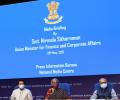
The GST Council on Friday left taxes on COVID-19 vaccines and medical supplies unchanged after the BJP- and Opposition-ruled states sparred over whether tax cut benefits will reach the common man. Congress and other Opposition ruled states have been demanding a reduction in taxes but the central government felt the move may not result in tangible gains for people. "It is one thing to rush to say - do this, it will benefit the common man. But when the technical, fitment and law committees go into the details, you realise that that could have collateral impact on many others," Finance Minister Nirmala Sitharaman said. "I am not talking about the revenue generation aspect, but how many other items will get included in it as a result of which how you are going to implement it," she added.

Experts have flagged issues regarding the levying of new cess/tax, especially those related to complications in administering the cess.

All eyes will be on whether Sitharaman provides the much-expected tax relief for the middle class, leaving more money in their hands, as there is tax buoyancy
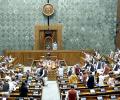
India's opposition parties have sharply criticized the Union Budget, calling it inadequate to address the country's economic woes and accusing the BJP-led government of using it to woo voters in Bihar and Delhi ahead of upcoming elections. Leaders from the Congress, TMC, DMK, SP, and CPI(M) voiced their disapproval, highlighting concerns over inflation, unemployment, and the lack of substantial measures to support the agricultural sector and the poor. They also criticized the tax cuts for the middle class as insufficient and coming too late after years of high taxes and rising prices.

The time is ideal for a 'Dream Budget' akin to the 1991 reforms that sparked high growth and unlocked significant gains in productivity, points out Rajeswari Sengupta.
GST council may propose a faster refund procedure, deferment of electronic way bill, further simplification of composition scheme

Under the GST law, states were guaranteed to be paid for any loss of revenue in the first five years of the GST implementation from July 1, 2017.

Facing a deepening slowdown, the auto sector is pinning hopes on the GST Council meeting on September 20 for a rate cut from 28 per cent to 18 per cent. However, states including Bihar, West Bengal, Kerala, and Punjab are of the view that the slowdown in the auto sector is not because of the GST rate but structural issues in the economy.

The revenues for August are 88 per cent of the GST collected in the same month last year.

The Budget should use the extra RBI surplus to better effect, suggests A K Bhattacharya.

The GST Council on Tuesday approved changes in tax rates on some goods and services while allowing states to issue an e-way bill for intra-state movement of gold and precious stones, officials said. The Council, chaired by Finance Minister Nirmala Sitharaman and comprising state counterparts, also cleared a host of compliance procedures for GST-registered businesses along with a GoM report on high-risk tax payers to check evasion. The discussion on the crucial issues of extension of compensation to states beyond June 2022 and the imposition of 28 per cent GST on casinos, online gaming and horse racing, will take place on Wednesday.

The opposition parties vehemently criticised the new 'one nation, one tax' system having four different rates instead of a single rate adopted in some countries including the UK and Singapore.

The GoM is likely to submit an interim report to the Council on pruning the list of items that at present do not attract the levy.
The finance ministry has set up two committees of state finance ministers which would rework rate slabs, review GST exempt items and identify potential evasion sources. Four years after the roll out of the national Goods and Services Tax (GST), which replaced the complex indirect tax structure, the centre and states have started work on moving towards a "simpler rate structure in GST" by reviewing the current rate slabs, including special rates and merger of rate slabs. The Group of Ministers (GoM) on rate rationalisation would also review items under inverted duty structure to help minimise refund payout, and review the supply of goods and services exempt under GST with an objective to expand the tax base and eliminate breaking of input tax credit (ITC) chain.

Parliament on Thursday cleared the decks for the rollout of the historic Goods and Services Tax from July 1 as it approved four supporting legislations to usher in the one-nation-one-tax regime.
Dissenting states including Chhattisgarh and Kerala, have made it clear they are in no mood to relent. They want the Centre to borrow the entire Rs 2.35 trillion this fiscal citing bleak fiscal position.
After the GST Council's meeting in March, the Centre had sought views from Attorney General K K Venugopal -- who is the chief legal officer of the government -- on the legality of market borrowing by the council to make good any shortfall in the compensation fund. The AG in his view said there is no obligation on the central government to pay the GST compensation shortfall, according to the sources.

The October 5 meeting assumes significance as the Centre and states are at loggerheads over the issue of funding Rs 2.35 lakh crore GST collection shortfall.
With its age-old fascination for education, southern states have done better than the North. Start-ups, IT hubs, and industry majors setting up shop have changed the face of the South. Nearly 79% of global offices set up by international conglomerates in India are in the South. Almost 46% of tech unicorns are from the South. The GDP per person in the South is 4.2 times higher than the North. None of these indicators can be ignored by any central government, whatever the political compulsions, notes Ramesh Menon.

The all-powerful GST Council on Friday decided to charge food delivery platforms such as Swiggy and Zomato a tax even as it extended concessional tax rates on certain COVID-19 drugs by three months till December 31. The Council, which comprises the Union finance minister and her state counterparts, decided to continue keeping petrol and diesel out of the GST purview as subsuming the current excise duty and VAT into one national rate would impact revenues. Briefing reporters on the decisions taken by the Council at a meeting here, Union Finance Minister Nirmala Sitharaman said GST has been exempted on muscular atrophy drugs like Zolgensma and Viltepso, which cost crores of rupees.

The Director General of Goods and Services Tax Intelligence (DGGI) has slapped its heftiest tax notice of Rs 21,000 crore on Bengaluru-based Gameskraft Technology (GTPL) for allegedly evading GST on the betting amount. Gameskraft has dubbed the notice a "departure from the well-established law of the land". The company is accused of promoting online betting through card, casual and fantasy games like Rummy Culture, Gamezy and Rummy Time.
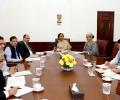
The aim of the exercise was to further simplify GST forms and make the filing process more user-friendly, the finance ministry said in a tweet, reports Dilasha Seth.
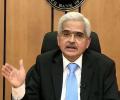
Reserve Bank Governor Shaktikanta Das on Tuesday said the fiscal-monetary coordination was at its best during the last six years even as he thanked Prime Minister Narendra Modi for giving the opportunity to head the monetary authority of the country. Das, in a series of posts on X, on his last day of his six-year term as RBI Governor, also thanked the Finance Minister, various stakeholders and his colleagues at the central bank.
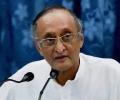
Stating that GST council meetings have become "almost toxic" with the erosion of trust between the Centre and states, West Bengal minister Amit Mitra on Wednesday urged Union Finance Minister Nirmala Sitharaman to consider a "course correction" to rebuild faith. In a letter to Sitharaman, the state's finance minister also claimed that the central government comes to GST council meetings with a "predetermined conclusion". Mitra on June 13 alleged that his voice was "muzzled" during the GST Council meeting on that day and his opposition to levy taxes on Covid essentials like vaccines, masks, PPE kits and anti-viral drug Remdesivir, was not heard.

After the 2019 election, one thing is sure: GST will see a number of changes, explains Indivjal Dhasmana.

Rajya Sabha witnessed heated exchanges between the treasury and opposition benches after Congress leader Mallikarjun Kharge made remarks on the manner in which political parties select women candidates from weaker sections and raised the issue of 'delayed' GST payments to non-Bharatiya Janata Party ruled states.

Leading brokerages have revised their charges with the true-to-label norms by the Securities and Exchange Board of India (Sebi) kicking in from Tuesday.

Steep taxes on petrol and diesel add to the cost of economic activity and reduce the Indian economy's competitiveness. The two fuels must be brought under GST's purview, suggests former IAS officer Ajay Shankar.

For every rupee in the government coffer, the biggest pie of 63 paise will come from direct and indirect taxes, according to the Union Budget 2024-25 documents.
Moody's Ratings on Tuesday projected general government debt to stabilise above 80 per cent of GDP over the next three years, down from 89.3 per cent in 2020-21. "General government interest payments to fall to around 24 per cent of general government revenue over the next two years from over 28 per cent in fiscal 2020-21, although this remains much higher than the median 8.7 per cent recorded by Baa-rated peers," Moody's Ratings associate managing director Gene Fang said in a post-Budget reaction.

The bulk of states' revenue comes from the devolution from the Centre's divisible tax pool, GST, VAT on petroleum, and excise duty on alcohol.
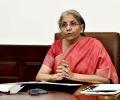
Amid record-high fuel prices, Finance Minister Nirmala Sitharaman on Monday said there is no proposal as of now to bring crude oil, petrol, diesel, jet fuel (ATF) and natural gas under the Goods and Services Tax (GST). When the GST was introduced on July 1, 2017, amalgamating over a dozen central and state levies, five commodities - crude oil, natural gas, petrol, diesel, and aviation turbine fuel (ATF) - were kept out of its purview given the revenue dependence of the central and state governments on this sector. This meant that the central government continued to levy excise duty on them while state governments charged VAT. These taxes, with excise duty, in particular, have been raised periodically.
